What Are the Best Car Factories in China?

China has become a major force in global vehicle manufacturing. Its leading factories produce electric cars, hybrids, commercial vehicles, and traditional models at impressive scale. However, identifying the “best” plant requires more than counting annual output. Quality consistency, battery safety, automation, worker training, supply-chain strength, and export reliability matter just as much.

This guide examines respected Chinese production centers linked with manufacturers such as BYD, Geely, SAIC, Chery, FAW, and NIO. It considers how factories manage visible details, including panel alignment, paint quality, software testing, and final inspection. It also looks at less obvious evidence, such as recall records, independent reviews, warranty support, and long-term owner experience. These details often separate a modern facility from a merely busy one.

Searches for “car factors” often confuse factories with brands, so the distinction deserves attention. A strong brand can still operate plants with different standards. Likewise, a newer smart factory may use advanced robots but lack years of reliability data. Factory tours can be useful. They are not complete proof. This article therefore compares available industry information, manufacturer disclosures, expert assessments, and real-world vehicle performance. The ranking may change as technology and investment move across China. That uncertainty is important. A factory that looks exceptional today may need to prove its consistency over many more years.
What Are the Best Car Factories in China?

Defining What Makes a Car Factory the Best in China

What Are the Best Car Factories in China?

Defining What Makes a Car Factory the Best in China

The best car factory is not simply the largest or newest. It delivers consistent quality under pressure. A practical evaluation should examine defect prevention, worker training, process traceability, energy use, and delivery stability. During an audit, small details matter: calibrated torque tools, barcode records, clean paint booths, and reliable end-of-line testing. These details reveal whether technology supports people or merely creates impressive demonstrations.

China’s manufacturing scale raises the standard. The China Association of Automobile Manufacturers reported 31.28 million vehicle units produced in 2024. New-energy vehicle production reached about 12.89 million units. Such volume requires flexible lines, disciplined suppliers, and rapid problem-solving. The International Energy Agency also identifies China as a central force in global electric-vehicle production. Therefore, a leading factory must manage batteries, software, and conventional components with equal control.

Quality data still deserves caution. A high output figure does not prove long-term reliability. The J.D. Power China Initial Quality Study shows how early ownership problems can expose weaknesses missed during factory inspections. Energy performance matters too. The International Organization for Standardization’s ISO 50001 framework offers a credible basis for evaluating energy management, but certification alone is not enough. Real excellence appears in lower scrap rates, transparent corrective actions, and stable results across ordinary shifts. Some factories remain too dependent on automation. That is a weakness worth questioning.

China’s Leading Automakers and Their Major Production Facilities

What Are the Best Car Factories in China?

China’s strongest car factories are defined by production scale, supply-chain depth, and export access. The China Association of Automobile Manufacturers reported 31.28 million vehicles produced in 2024. New-energy vehicles represented 12.89 million units. These figures show industrial strength, but volume alone cannot prove quality.

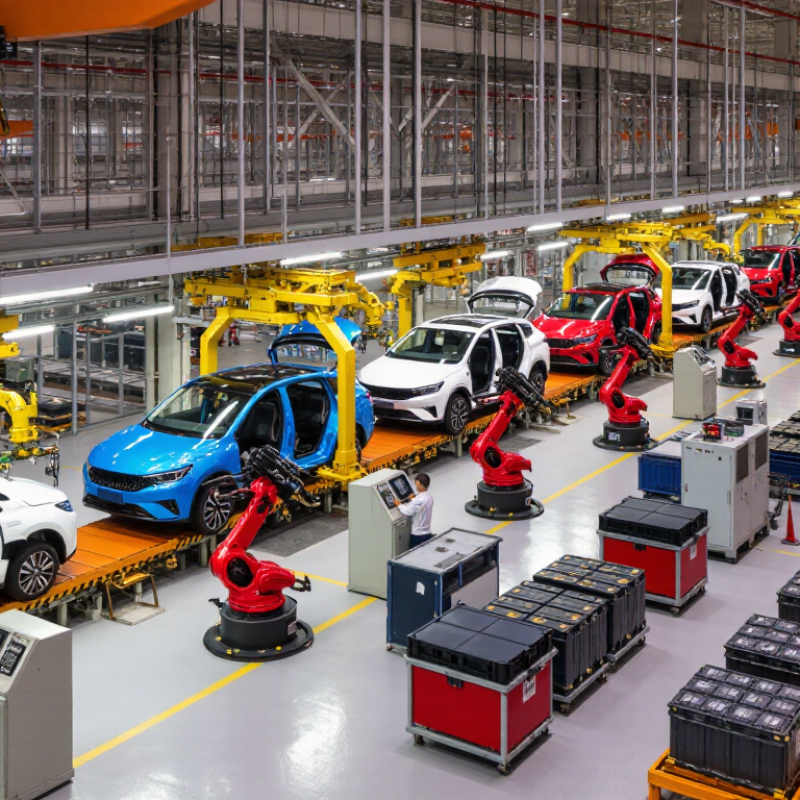
Major production facilities cluster around Shanghai, Guangzhou, Shenzhen, Wuhan, Chongqing, Hefei, and Changchun. Coastal plants benefit from container terminals and dense supplier networks. Inland factories often connect with high-speed rail and national logistics corridors. Inside many facilities, automated welding cells work beside battery assembly areas. Workers monitor torque readings, panel gaps, and software tests on digital screens. The International Energy Agency reported that China produced more than half of the world’s electric cars in 2023. That position reflects mature battery supply chains and fast factory expansion.

The most capable plants also shorten development cycles. Engineers can test vehicle software near stamping, paint, and final assembly lines. This arrangement supports quick production changes. It is efficient, though not flawless. A polished line can still create uneven repair quality. The Organisation Internationale des Constructeurs d’Automobiles recorded over 30 million Chinese vehicle builds in 2023. That scale deserves attention, but independent audits, warranty data, and worker safety records remain essential. The best factory is not always the largest one. It is the facility that repeatedly delivers consistent vehicles, transparent data, and dependable after-sales support.

What Are the Best Car Factories in China? — China’s Leading Automakers and Their Major Production Facilities
Facility ID City and Province Established / Major Expansion Primary Vehicle Output Electrification Capability Estimated Installed Capacity Strategic Logistics Advantage Operational Profile
Facility 01 Shanghai Municipality 1990s; expanded during the 2010s Passenger cars, premium vehicles, and new-energy vehicles Battery-electric assembly, high-voltage systems, and intelligent-vehicle integration More than 1 million vehicles per year across the local manufacturing complex Direct access to Yangshan Deep-Water Port, expressways, rail freight, and the Yangtze River Delta supplier base Export-oriented
Facility 02 Guangzhou, Guangdong Province 2000s; multiple line expansions Passenger cars, sport-utility vehicles, sedans, and hybrid models Hybrid, plug-in hybrid, and battery-electric production lines Approximately 1 million vehicles per year across major local plants Close to Nansha Port, the Pearl River Delta supplier network, and major southern transport corridors High-volume hub
Facility 03 Wuhan, Hubei Province 1990s; upgraded for electric vehicles in the 2020s Passenger cars, commercial vehicles, and electric models Battery-electric platforms, battery-pack integration, and flexible mixed-power production Roughly 1 million vehicles per year across the wider manufacturing base Central-China location with access to river shipping, high-speed rail, expressways, and national distribution routes Multi-powertrain
Facility 04 Chongqing Municipality 1950s onward; large-scale modernization since the 2010s Passenger cars, light commercial vehicles, and sport-utility vehicles Battery-electric and plug-in hybrid production, supported by local battery suppliers More than 1.5 million vehicles per year across the city’s major production network Strong western-China supplier ecosystem, rail links to Europe, and access to the Yangtze River corridor Large industrial cluster
Facility 05 Changchun, Jilin Province 1950s; successive modernization programs Passenger cars, luxury vehicles, trucks, and other commercial vehicles Hybrid and battery-electric lines added alongside conventional vehicle production Approximately 1 million vehicles per year across the principal industrial complex Deep automotive supplier base in Northeast China and direct rail connections to domestic and international markets Full-range production
Facility 06 Hefei, Anhui Province 2000s; rapid expansion during the 2020s Battery-electric passenger cars, smart vehicles, and selected commercial models Dedicated electric-vehicle assembly, battery systems, software integration, and automated production More than 1 million vehicles per year across major nearby facilities Central location, strong electronics and battery supply chain, and efficient access to Shanghai and eastern export ports NEV-focused
Facility 07 Xi’an, Shaanxi Province 2000s; expanded substantially in the 2020s Battery-electric passenger cars, buses, and commercial vehicles High-volume battery-electric production and battery-pack manufacturing Approximately 1 million vehicles per year at full planned scale Strategic western location with rail freight to Europe, access to national highways, and proximity to inland battery suppliers Electric mobility hub
Facility 08 Ningbo, Zhejiang Province 1990s; expanded through the 2010s and 2020s Passenger cars, compact sport-utility vehicles, and electric models Battery-electric and plug-in hybrid assembly with flexible vehicle platforms Several hundred thousand vehicles per year across the local production base Proximity to Ningbo-Zhoushan Port, one of the world’s busiest container gateways, plus a mature Zhejiang supplier network Export-capable
Facility 09 Zhengzhou, Henan Province 2000s; major new-energy expansion in the 2020s Passenger cars, electric vehicles, and selected commercial vehicles Battery-electric assembly, battery production, and integrated new-energy vehicle manufacturing Several hundred thousand vehicles per year, with additional expansion capacity Central location, extensive rail freight connections, and efficient distribution to northern, eastern, and western China Expansion hub
Facility 10 Shenzhen, Guangdong Province 1990s; upgraded into a large new-energy manufacturing base Battery-electric passenger cars, buses, trucks, and specialty vehicles Vertically integrated battery systems, electric drivetrains, and commercial-vehicle platforms Several hundred thousand vehicles per year across local facilities Access to Shenzhen and nearby southern ports, electronics suppliers, and advanced logistics infrastructure Vertically integrated
Capacity figures are indicative installed or publicly reported design capacities for major local manufacturing complexes, rather than guaranteed annual output. Actual production varies with market demand, model allocation, supply conditions, and plant utilization.

How Chinese Car Factories Compare in Technology and Efficiency

China’s strongest car factories are increasingly judged by measurable execution, not factory size. The International Federation of Robotics reported 276,288 industrial robot installations in China during 2023, representing about 51% of global installations. In practice, this means automated welding cells, camera-based inspection, and guided material vehicles can reduce repetitive errors. The factory floor becomes quieter, faster, and more traceable.

Energy efficiency is also changing the comparison. The International Energy Agency reported that China produced more than half of the world’s electric cars in 2023. This scale supports shorter battery logistics routes and faster process learning. Many plants now connect production equipment to manufacturing execution systems, tracking cycle time, downtime, and electricity use. The World Economic Forum’s Global Lighthouse Network has also highlighted Chinese manufacturing sites for advanced analytics and smart automation.

Technology is not automatically efficiency. Robot density can look impressive while rework, training gaps, or supplier delays remain hidden. I would examine first-pass yield, unplanned downtime, water consumption, and energy used per vehicle. Public factory data is still incomplete. That matters. A polished demonstration line may not represent every shift. The best facilities appear to combine dense automation with disciplined workers, local supplier coordination, and rapid quality feedback. Some still need better transparency, especially for lifecycle emissions and battery-material traceability. Perfect? Not yet.

Electric Vehicle and Battery Manufacturing in China’s Car Industry

What Are the Best Car Factories in China?

Electric Vehicle and Battery Manufacturing in China’s Car Industry

The best car factories in China are not judged by size alone. Their real strength appears in battery safety, process control, and consistent vehicle quality. A reliable assessment should examine production records, independent audits, recall history, and worker training. Factory efficiency matters, but it cannot replace careful engineering.

Battery manufacturing deserves close attention. Modern facilities often separate cell production from vehicle assembly. Clean rooms control dust and humidity. Automated systems inspect electrode coating, welding points, and cell dimensions. Each battery pack should carry traceable data from raw materials to final testing. Thermal management is equally important, especially during fast charging and extreme weather. Battery quality decides trust.

Electric vehicle factories also depend on software and electronics. Technicians test charging systems, braking controls, sensors, and emergency shutdown functions. A strong plant records small defects instead of hiding them. That practice improves future production. It also reveals a difficult truth: automation reduces some errors, but it creates new risks when workers rely on inaccurate data.

The factory floor feels different.

Independent testing remains essential. A polished showroom cannot prove long-term reliability. Buyers and analysts should compare battery warranties, service procedures, energy efficiency, and real-world durability. Some factories still need clearer reporting on recycling, mineral sourcing, and battery replacement costs. Honest criticism is useful here. It encourages safer design, better disclosure, and more responsible growth across China’s car industry.

Key Factors for Evaluating China’s Best Car Factories

Evaluating China’s best car factories requires more than counting vehicles. Production scale matters, but consistency, safety, worker expertise, and supplier control matter more. The China Association of Automobile Manufacturers reported 30.16 million vehicles produced in 2023. New-energy vehicle output reached about 9.59 million units. Output is only one clue.

A strong factory should show stable defect rates across long production runs. Auditors should examine weld accuracy, paint thickness, battery traceability, and final inspection records. The International Energy Agency reported that China sold more than eight million electric cars in 2023, representing nearly 60% of global electric-car sales. Such volume can strengthen manufacturing learning, but it can also expose weak quality systems quickly. Fast expansion is not automatically excellence.

Energy use and emissions also deserve close attention. The International Organization for Standardization’s ISO 14001 framework can help assess environmental management, although certification alone proves little. Factories should publish measurable energy, water, waste, and recall data. After-sales response is another practical test. Can replacement parts arrive within days? Can technicians explain a battery fault clearly? I would also inspect overtime practices and training records, because tired workers can undermine sophisticated automation. A factory may appear impressive during a guided tour. That judgment can be incomplete. Independent audits, warranty trends, and customer-reported failures provide a more honest evaluation.